Flying Smart
Delayed or Cancelled in the US: What the Airline Owes You
Passengers whose flights have been canceled or significantly delayed are now entitled to automatic cash refunds under a new rule from the U.S…
Home › Flying Smart › Why boarding on flights is so slow - and the boarding strate
Flying SmartImagine you are on flight 435 to London Heathrow. The airline boards the plane in five zones. As a Zone 4 passenger, you board last. Why does the airline do this, and do these zones actually work?
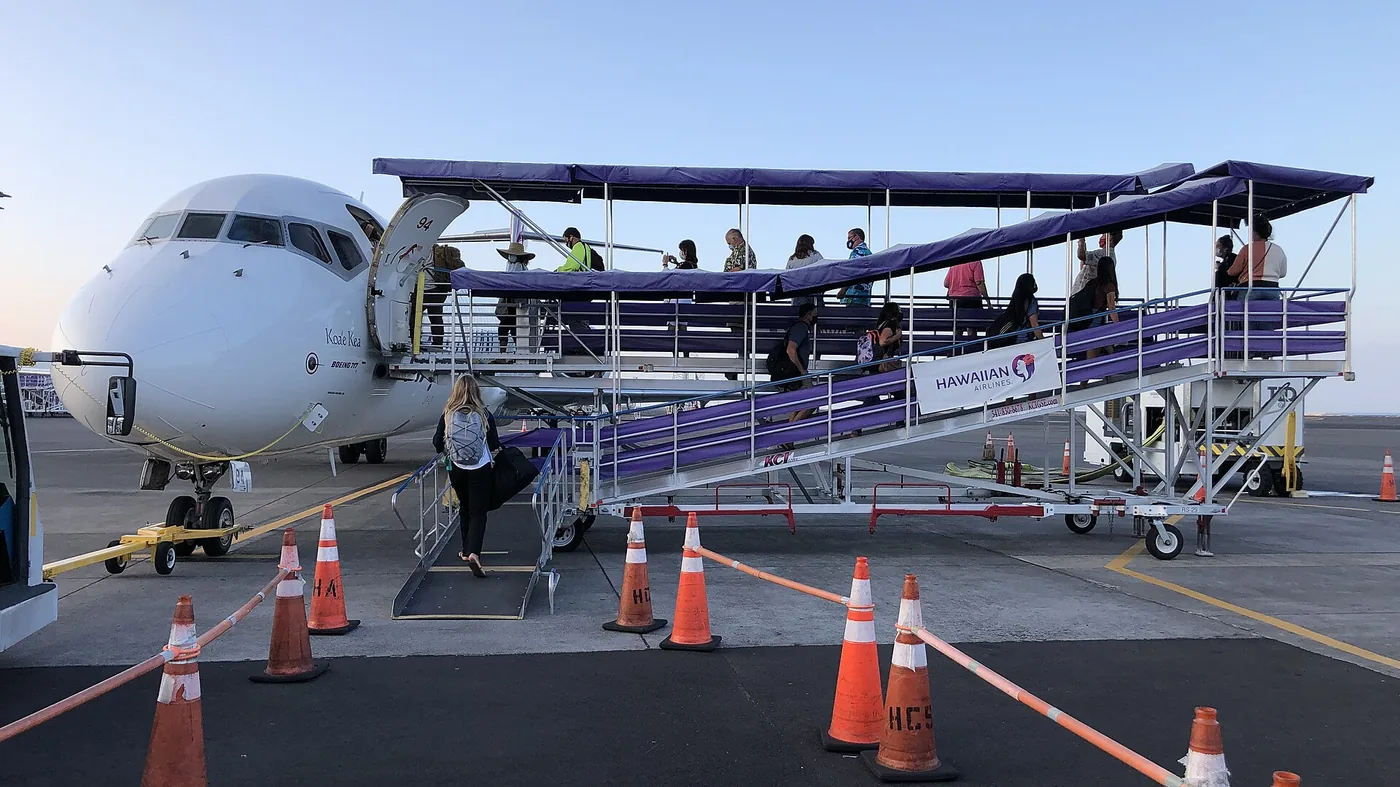
The primary reason boarding takes so long is that passengers block each other in the aisle. But how quickly the boarding unfolds is affected by the boarding method used.
Airlines use different methods to influence boarding speed and passenger experience. The boarding method used affects how much time it takes for everyone to board.
Customary boarding methods like back-to-front or by blocks are not always the quickest. Other methods clock faster boarding times, with the best options reducing the time spent in the aisle.
Frequent-flying passengers pay an arm and a leg to get an early boarding position. But is early boarding worth the extra cost, and does it actually mean you get to board faster?
Airlines avoid chaos by boarding by rows, blocks, or zones, but randomised boarding can actually be quicker. In reality, since passengers have specific seats, randomising the order of boarding in a large plane may only shave about a minute off overall times.
Many passengers wait for their row number to be called before boarding, then rushing to their seats to unload bags into the overhead bin before the crowd.
More passengers board an aircraft, the longer the boarding process will take. The airplane boarding problem is a fundamental research problem that matters to the aviation industry. It measures whether one boarding method is more efficient than another.
Airlines often board passengers in a fixed order, to prevent groups from having to hold up the boarding process by standing in the aisle for longer than necessary, or needing to wait for a passage to unload their baggage.
While a simple back-to-front boarding may seem like the fastest option on the face of it, physical experiments and computer simulations run in various settings have repeatedly shown that other methods outperform it.
Generally, an airline will choose a boarding method based on a combination of the overall time it takes to complete, the likelihood of causing conflicts, and the relative ease of managing the boarding itself.
The method that works best from balancing these factors varies depending on aircraft dimensions, the number of passengers and what proportion of them are bringing carry-on luggage. There is no universal perfect method, but certain methods tend to score well across a variety of circumstances.
In head-to-head time trials, a combination of the WilMA (Window-Middle-Aisle) and Window-Random-Middle method performs the best.
It has been tested in both physical experiment and computer simulation, vs the likes of back-to-front, blocks, and multi-row boarding.
Even with a challenging set-up, such as a full flight with high proportion of passengers carrying large bags, the WilMA/WRM boarding still comes in ahead in both studies against random boarding
In the real world, WilMA can convert to a time saving of a minute over back-to-front and blocks.
Not all tested approaches that make boarders more random are winners. Some block-based boarding approaches in particular lose time vs random.
Back-to-front, by block and by zone are commonly found in practice. If you are sitting at the back of the plane, prepare to wait.
Back to front boarding is so common, in fact, that it is widespread despite being shown to be underperforming in most situations. In one physical experiment, it took 6 minutes and 16 seconds, while boarding by blocks was slower still at 6:54.
In computer simulations, even more dramatic results emerge. Where two closely equivalent imaginary routes were boarded using a back-to-front method on one flight and random boarding on another, the random option shaved a meaningful amount off the total boarding time.
Properly constructed random boarding can produce more efficient results than simple structured alternatives, simulation studies repeatedly show.
Techniques such as spread boarding, and random boarding where passengers are instructed to include time-saving gaps between them at ground level, fare well in trials.
Round-robin boarding, where each zone takes two rows of the plane, creating space for the other groups to move more freely, is also shown in some contexts to be a winner.
The advantage of random boarding often decreases with smaller aircraft or lower passenger counts.
When there is a heavy proportion of bags or the plane is near capacity, the time gained from random is almost invariably lower, due to the nature of the boarding problem.
Experiments show that we may interpret the social nature of the boarding experience differently than we expect. Passengers may be more diligently obeying instructions, for example, than we would predict. Studies also frequently find that a crowd of passengers knows better than to block the aisle itself, whatever the order they are given so far.
The importance of carry-on luggage varies by study, but it produces a consistently negative impact on overall boarding time.
By incorporating different luggage scenarios into their analyses, researchers have shown that the ranking of effective boarding methods can shift, with factors like longer waits at the front of the plane becoming more important, depending on how bags are stowed.
The existence of bags also changes people's behaviour at the seat. Rather than taking their seat and moving on, they will keep the seat occupied while unloading, interfering with those who come after them.
Studies vary in just how much more time the carry-on luggage adds. Larger studies run at busy airline hubs tend to produce heavier averages.
One study found evidence to suggest that boarding by rows is more likely to lead to passengers leaving their bags in the aisle, due to the more compressed boarding.
The evidence is mixed as to whether carry-on weight will encourage more people to try to board early, and where there are plenty of passengers looking for a spot to unload, the effects can be seen either way.
Studies have addressed the question of not just speed, but the importance of the boarding techniques in terms of the airline's own goals.
A further factor is the relative value of things like time for passengers in general, or for groups who get priority at boarding, and the willingness of passengers to buy early boarding privileges.
Airlines may optimise in practice for the self-check-in numbers they are trading off against the boarding speed. There is also a balance in how much the material difference between boards is, and what the balance of people they are trying to satisfy is, in relation to their marketing around boarding.
The great thing about random boarding, many airline's operators argue, is that there's no need to upgrade airport systems, and everyone is equally happy in the end.
These choices come in the context of airports with their own aim for efficiency, and where the potential lost time stuck at a gate can be prohibitively high, depending on the number of flights and the size of the airport itself.
Why we published this. An understanding of what actually slows a boarding, and how to be in the fast half of it.
Passengers whose flights have been canceled or significantly delayed are now entitled to automatic cash refunds under a new rule from the U.S…
When packing for your next flight, make sure to check your airline's carry-on size rules. The regulations governing cabin baggage are a mix of…